
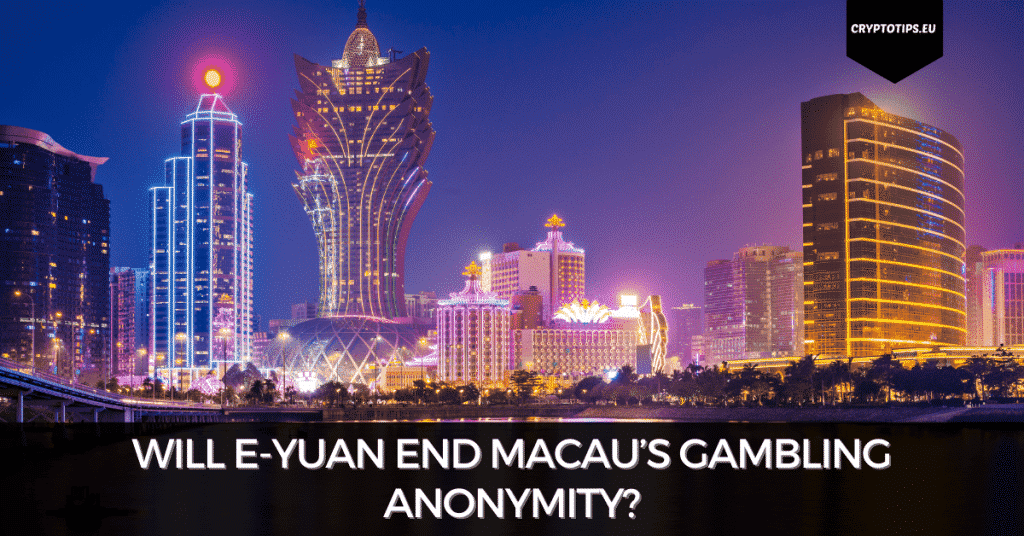
Will E-Yuan End Macau’s Gambling Anonymity?
Last Updated on 1 May 2021 by CryptoTips.eu
Macau, HongKong and Shanghai have a special meaning for the Beijing government. Given that these coastal cities are so important for China’s economy, they are often granted exceptional regulations, such as the democratic rights that HongKong is given or the fact that gambling is forbidden in mainland China but overlooked in Macau.
In essence, Beijing renames them as Special Administrative Region mostly in order to allow them certain freedoms which are not granted on the mainland.
Compare it to Las Vegas in the US. While gambling and sports betting is illegal mostly everywhere in the US, in Las Vegas it is widely accepted. Americans often go to Vegas with a stack full of cash, lose a lot of money and then return home without their spouses ever knowing what went on.
A business trip is often a convenient excuse (which is also why there are so many conferences organized in Vegas. Hence the saying: What happens in Vegas, stays in Vegas.
Employment, e-yuan and elections: World market themes for the week ahead https://t.co/dIur2aOZ3L
— Report on Business (@globebusiness) April 30, 2021
Macau is basically the same, but for the Chinese who have loved gambling during all of their history.
However, the countrywide introduction of the E-Yuan (the digital version of the Renmibi or RMB) is causing a problem for the gambling-mad Chinese, and certainly the government of Macau.
With 70% of their revenue coming from the tourists arriving from mainland China, mostly with cash in hand, that could be about to see a major change.
End all physical cash
An opinion piece in Macau Business this week claimed that the introduction of the E-yuan would replace all physical RMB cash in circulation, a nightmare scenario for Macau.
Executives, who are all too happy to see mainland Chinese tourists arrive in droves, fear that the introduction of the E-Yuan will come with a loss of anonymity, as Beijing will be able to track all gambling losses from now on.
Take Five: Employment, e-yuan and elections - https://t.co/VqFM9KWmg5
— Investing.com News (@newsinvesting) April 30, 2021
Speaking anonymous to Reuters recently, an executive admitted that:
It’s such a high-level policy no one can really do anything. We just have to follow right and as an operator make sure our systems will be compatible.
